Don't just protect your children. Build the future with them.
- Jun 9
- 4 min read

Should we organize society around fear of what we want to avoid, or in love of what we want to create? Because achieving something doesn't happen while we're hiding. We're the adults now. We're building the spaces our children grow up in.
We adults, the news, and schools are often good at teaching children what to beware of. But what if we first taught them what is worth building? What is worth creating, caring for, and transforming.
Many of us are so busy that we hardly ever have time to look up. We have put our bodies in second gear and are slogging through the day.
We respond to messages.
Check what's new.
Checking the weather.
We can know what's happening around the world, and what our neighbors' acquaintances think about food prices, but still stand in front of the refrigerator without a plan.
At the same time, we keep a good overview of everything that could go wrong.
Screens. Artificial intelligence.
Consequences of stress.
Loneliness. Bad food.
And from this place we often initiate the education of our children.
We teach them what to avoid.
What could harm them.
What is not allowed.
But is this where it should start? We don't start a child's relationship with food by showing them poisonous plants and mushrooms. We start with a meal. With taste, smell and warm hands around a table. We teach them the joy of food from the garden and forest, preparation and community. We show them what food can be when it brings people together.
Only later do we teach them what is dangerous. An important subset, not the story itself.
Because I think it matters to us which images we start with.
When we teach children what makes them grow, they recognize for themselves what makes them shrink. In this way, we do not close our eyes to the difficult. But we do not let fear paint the entire future alone.
Perhaps much of what we worry about is not just individual issues that we need to solve individually. Perhaps it is a symptom of something bigger: a community that has become too thin. When the community becomes stronger, many of the symptoms disappear on their own.
Don't "fix yourself." But: "Let's build better spaces together."
Then we don't need to protect ourselves from more and more things. We start to get along better.
Can we also say this about technology? About artificial intelligence?
In the debate, we need the naysayers. Those who put the brakes on. Not out of fear, but to ensure that the best values are carried forward. Those who ask questions and challenge. I am a bubbling future enthusiast, who needs a good naysayer to get a balanced end result. But what we don't need is for the brakes to disengage from the car, pull themselves under their arm and go home in disapproval. Then the very voice that is needed most is missing when the future is being shaped and the turns can quickly become too abrupt without brakes.

In the same way, we need children and young people to be able to react and say no without us seeing them as difficult or problematic. Unsuitable or ill-adjusted to society and "adult life". Perhaps they sometimes point out what we adults have become too accustomed to.
At school. At work. In everyday life.
Maybe they shouldn't accept that technology is stealing our attention.
Maybe they shouldn't accept food that loses the taste of life.
Maybe they shouldn't accept that adults are always short on time.
Maybe they shouldn't accept that moving is a behavioral problem.
Maybe they shouldn't accept a future where nature becomes something we visit but don't live in.
Maybe they shouldn't accept long working hours 5 days a week
Perhaps none of us should accept that there are two camps when it comes to AI.
Or believe that we must decide whether AI is good or evil. This is how the conversations end: are you for or against? Both sides are the same side: Most have the good of the community as their goal.
A good starting point for achieving something together instead of avoiding each other.
Because if we do not participate in the conversation about the future, others will shape it for us. Those who own the technology. Those who already hold power. Those who have the greatest financial gain from development. Then we can only hope that these are the same people who also govern with good heart values. Otherwise, we may have to recall Øverland's words before we are struck by having waited too long: "You must not endure so heartily the injustice that does not affect you."
Let's be clear about what we want technology to give us, so we can paint a positive worldview and a good future for our children. This will be different for everyone, but perhaps something along these lines: More time with those we love and a more human everyday life. More closeness to nature. More equitable distribution of resources and opportunities. More space for care, creativity, cycles and community.
Ethical technology where the direction, access and benefits belong to the community. Think it, say it, spread it and let it be your future.
It's easy to be proud of being against something. But perhaps we can also be proud of being the ones who tilt the future in the right direction, whether it's with a no or a yes.
Not naive. Not uncritical. Not disconnected. But creative.
No longer acting in fear of what we want to avoid. But in love of what we want to achieve. This is how we can teach children to approach the world of the future with hope and joy.
Can you feel the difference?
One makes the body smaller. The other gives the future more space.
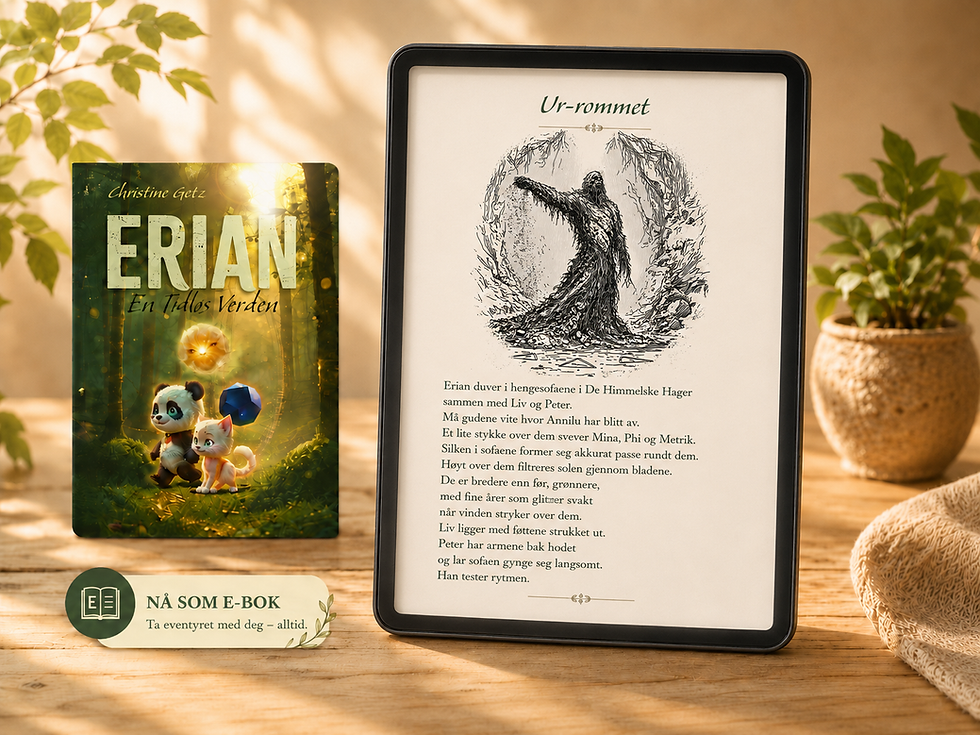
Christine Getz, debut author.


Comments